

Along the Nabatean Highway: Kingdoms of Sand & Stone


Arrival in Jordan & Evening Flight to Medina
Trace the footsteps of ancient merchants, pilgrims, and empires on an extraordinary 10-day journey bridging two kingdoms. From the sacred architecture of Medina and the mirrored illusions of AlUla to the dramatic red sands of Wadi Rum and the rose-red stone of Petra, this itinerary follows the legendary trade routes that shaped human history.
You’ll traverse a landscape of dramatic contrasts: wandering through the "Lost City" of Petra, sleeping under the star-studded canopy of Wadi Rum, and exploring the ancient Nabataean tombs of AlUla. This itinerary is designed for the curious traveler who wants to witness the seamless blend of deep-rooted heritage on an extraordinary journey through the "sands of time"
Itinerary at a Glance
-
Day 01: Arrival in Jordan. Evening Flight to Medina .
-
Day 02: Medina to AlUla. Sacred history at Quba Mosque (1st mosque built in Islam ) & Mount Uhud. Cross the volcanic Khaybar Oasis to AlUla.
-
Day 03: AlUla Ancient Echoes. Dadan tombs, Jabal Ikmah inscriptions, AlUla Oasis and the mirrored Maraya & old town of AlUla
-
Day 04: Hegra & Desert Wonders. SteThe Nabatean tombs of Hegra, Shara'an safari and sunset at Elephant Rock.
-
Day 05: Wadi Al Disah to Tabuk. 4 x 4 canyon expedition, lunch at a desert farm and the land of Moses & walk in old city of Tabuk.
-
Day 06: Tabuk to Wadi Rum 7 Bedouin Experience. Cross into Jordan, 4x4 Bedouin jeep safari and starlit desert camping.
-
Day 07: The Rose - Red City of Petra. Walk the dramatic Siq to uncover The Treasury and ancient Royal Tombs.
-
Day 08: Petra's via the back door and on to The Dead Sea. Hike the secret traders route to The Monastery and then head to the lowest place on Earth.
-
Day 09. Full- day on the Dead Sea for relaxation.
-
Day 10: Departure. Farewell to the Nabatean Kingdoms.




Trace the footsteps of ancient merchants, pilgrims, and empires on an extraordinary 10-day journey bridging two kingdoms. From the sacred architecture of Medina and the mirrored illusions of AlUla to the dramatic red sands of Wadi Rum and the rose-red stone of Petra, this itinerary follows the legendary trade routes that shaped human history.
You’ll traverse a landscape of dramatic contrasts: wandering through the "Lost City" of Petra, sleeping under the star-studded canopy of Wadi Rum, and exploring the ancient Nabataean tombs of AlUla. This itinerary is designed for the curious traveler who wants to witness the seamless blend of deep-rooted heritage on an extraordinary journey through the "sands of time"


Depart Jordan on an Early Evening Flight to Medina
Your journey begins in Jordan before connecting on an evening flight to Medina, the second holiest city in Islam.
Nestled within a fertile oasis bounded by the dramatic volcanic fields and arid hills of the Hejaz mountain range, Medina is a city of profound spiritual majesty. Surrounded by hills and mountains (Mount Uhud) , this ancient oasis, originally known as Yathrib, is the cradle of the Islamic calendar, marking the Prophet Muhammad’s fateful hijrah (migration) in 622 CE.
The absolute heart of Medina is Al-Masjid an-Nabawi (The Prophet’s Mosque). Originally a simple palm grove structure, a succession of caliphs, Ottoman sultans, and Saudi rulers expanded it into a sprawling architectural marvel. Its iconic Green Dome shelters the tombs of the Prophet, Abu Bakr, and Umar.
While Medina seamlessly integrates modern infrastructure, it retains a serene, contemplative atmosphere compared to busier Saudi cities.
While the city's historic quarters, modern hotels, and transport links are accessible, the Prophet’s Mosque and other designated holy sites are strictly reserved for Muslims. Non-Muslim visitors can still appreciate the vast magnitude of the Prophet’s Mosque complex by walking around its vibrant perimeter, observing a timeless destination where centuries of history and deep devotion converge.


Sacred Medina and the Volcanic Khaybar Oasis
The morning in Medina breaks with a quiet majesty. We begin our exploration tracing the dawn of an empire, first standing before the white minarets of the Quba Mosque, where the very first stones of Islamic history were laid. From there, the journey moves toward the monumental heart of the city; even from the outer perimeter, the sheer scale of the Prophet’s Mosque (Al-Masjid an-Nabawi) is breathtaking, its vast courtyards humming with a timeless, spiritual energy.
We then track the Ottoman ambition at the Hijaz Railway Station. Stepping onto the tracks, you can almost hear the iron roar of the old steam engines that once conquered the desert, miraculously shrinking a grueling 40-day camel trek down to just five. Next, the horizon shifts dramatically as we approach Mount Uhud. This colossal, 7-kilometer spine of crimson granite and fractured black rock rises sharply against the blue sky, anchoring the landscape with its heavy, storied past from the turbulent, earliest days of Islam.
By afternoon, the city fades into the rearview mirror as we strike out into the wild. The road toward AlUla cuts through a surreal, blackened terrain: the Khaybar Volcanic Desert. It is an otherworldly expanse of basalt fields and jagged craters that feels entirely cosmic, yet hides the ruins of a forgotten kingdom and a resilient, hidden ecosystem. This is where the true spirit of exploration takes hold, navigating the raw, elemental bridge between ancient prophecy and the deep, silent desert.

Labyrinths, Libaries & Mirages
Sunrise ignites the sandstone valley as we plunge into the dawn of Arabia’s lost empires. Guided by a Rawi—a local storyteller, whose voice breathes life into the dust—we confront the sheer cliff faces of Dadan, where the monumental, rock-cut tombs of the ancient Dadanite and Lihyanite kings peer out over the desert floor. A short journey away lies Jabal Ikmah, a breathtaking canyon acting as an open-air library, its canyon walls heavily scored with petroglyphs and inscriptions carved by ancient travelers nearly three millennia ago.
Escaping the midday heat, we slip into the emerald canopy of the AlUla Oasis. Under a rustling roof of date palms, we walk along cool paths fed by ancient springs, catching the sweet scent of a harvest that still yields 90,000 tonnes of fruit annually.
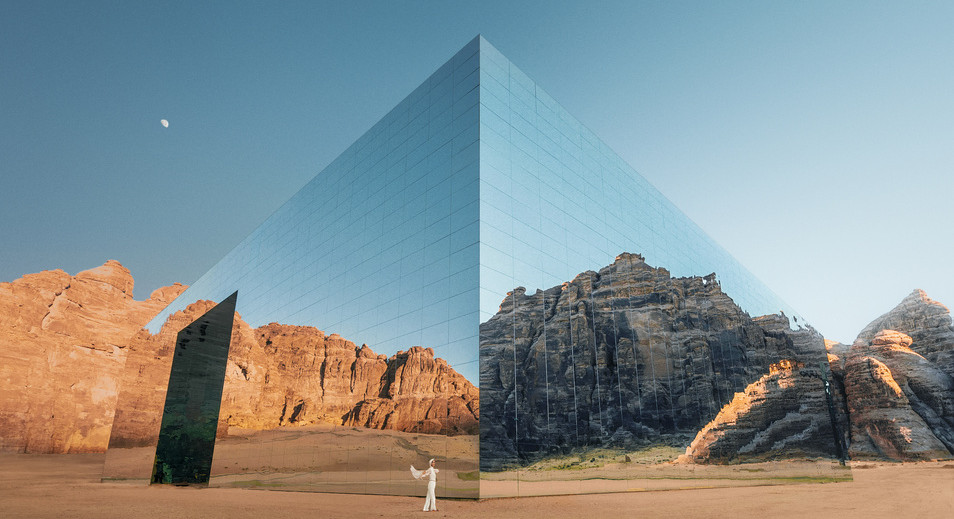
By mid-afternoon, we chase a modern mirage into the Ashar Valley: Maraya. Arriving for the final guided tour, this architectural marvel—the world's largest mirrored building—perfectly reflects the shifting gold and crimson of the surrounding canyons, blurring the line between human artistry and raw nature.
At the end of this beautiful day, you will enjoy a remarkable walk in the Old Town of AlUla. As twilight descends, we wander a labyrinth of hundreds of mud-brick houses packed tightly together like an impenetrable desert fortress. Moving through these narrow, winding alleys, the air grows heavy with a millennium of memories, concluding our expedition where history feels entirely tangible.

Tombs of Hegra & Shara'an Desert Safari
Morning breaks over the desert as we ignite our engines and venture straight into the rugged, untamed wilderness of the Shara’an Nature Reserve for an exhilarating off-road safari. Bouncing across sweeping dunes and navigating hidden canyons, we scan the jagged terrain for rare desert wildlife, completely immersed in the raw, cinematic isolation of AlUla’s protected backcountry.
Dusty and exhilarated, we transition from the wild to the majestic, stepping straight into antiquity at Hegra (Mada'in Saleh). As Saudi Arabia’s premier UNESCO World Heritage Site, this ancient Nabatean outpost strikes a profound chord. We wander among more than 100 monumental tombs carved with surgical precision into standalone sandstone monoliths. A closer look reveals the genius of a forgotten empire: sophisticated, stone-lined water channels and defensive Roman-style towers that once guarded these lucrative trade routes from unwanted eyes.
As the blazing sun dips toward the horizon, our expedition guides us to the iconic Elephant Rock, rising 52 meters like a colossal monolith sculpted by millennia of wind. Here, the frantic pace of exploration yields to pure desert magic. We sink into the cooling sand under a rapidly darkening sky, watching the massive sandstone frame glow a deep, brilliant crimson. Wrapped in the stillness of the desert with a fire pit crackling nearby, we look up as the first stars pierce the Arabian night, capping an unforgettable day of discovery.

Wad Al Disah & Expedition to Tabuk
Leaving AlUla behind, striking north on a three-hour drive toward Wadi Al Disah, a place of pure, cinematic adventure. Cresting the plateau, the desert floor suddenly drops away into a spectacular, hidden canyon where monumental sandstone cliffs dwarf everything below. We transfer to a 4x4 and plunge deep into the valley, splashing through freshwater springs and weaving between dense groves of wild palm trees that thrive against the towering, blood-red rock faces. This rugged trek leads us to a secluded local farm, where we pause to savor a traditional lunch under the shade of the orchards.
Rejuvenated by the oasis, we board our vehicles for a 2.5-hour drive further north to Tabuk, an ancient archaeological hub famously steeped in the epic history of the Prophet Moses, who sought refuge in these lands for a decade.
As twilight bleeds into the sky, the true exploration of Tabuk begins with an atmospheric evening walk in the historic Old City. The desert heat gives way to a cool breeze as we wander past ancient mud-brick foundations and century-old market stalls. The scent of cardamom and roasting coffee fills the narrow lanes, while the soft glow of lanterns illuminates the intricate woodwork of old merchant houses. Walking these timeless paths under the stars, you can feel the pulse of a crossroads that has welcomed travelers, prophets, and traders for thousands of years.


Kingdom of Jordan & Land of the Bedouin
Heading north from Tabuk, tracking the ancient routes of prophets and nomads. Our first desert stops feel like turning the pages of antiquity. We pause at the haunting, rock-cut Jethro Tombs carved into the cliffs, then visit the legendary Moses’ Well, an ancient watering hole rich with biblical lore. Dust cleared, we hit the coast and cross the Durrah border, leaving Saudi Arabia behind to enter the Hashemite Kingdom of Jordan.
From the border, we strike out straight into the ochre-tinted sands of Wadi Rum, the legendary "Valley of the Moon." The modern world vanishes as we climb into the back of a 4x4, driven by a local Bedouin who navigates the trackless dunes with effortless grace. We race beneath towering monolithic mountains to reach Lawrence’s Spring, a hidden desert lifeline, before squeezing into the cool, narrow eco-system of Khazali Canyon. Here, we run our fingers over ancient Nabatean petroglyphs and nomadic rock art etched into the stone millennia ago.
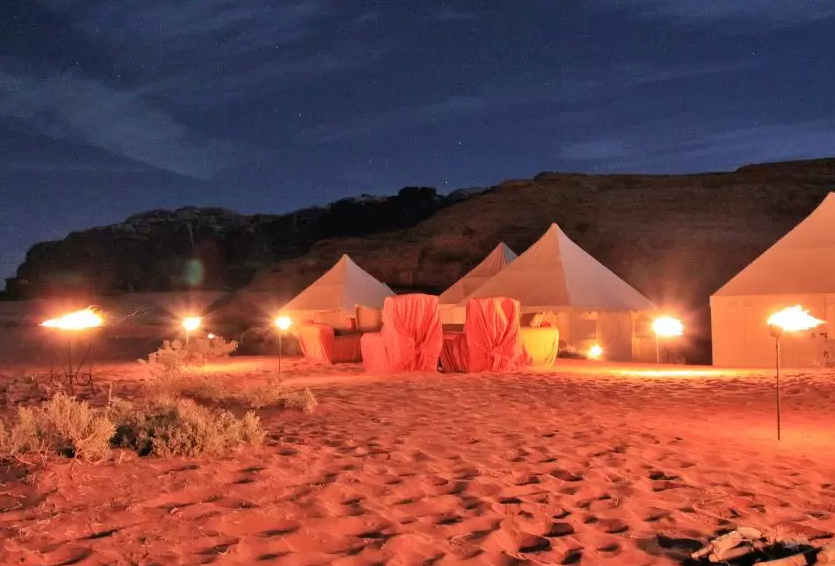
As the sun begins its final descent, the entire desert ignites, shifting from gold to a fierce, fiery red. We pull into a secluded camp just as the temperature drops, welcomed by the rich aroma of a traditional feast slow-cooked beneath the sand. Wrapped in heavy woven blankets around a crackling fire, we enjoy legendary Bedouin hospitality as the sky transitions into an ink-black canopy, ablaze with millions of stars completely untouched by modern light.
The Rose Red City of Petra
Following a dawn awakenign we depart for the crown jewel of the Nabatean Kingdom: the legendary city of Petra. The anticipation builds as we enter the ancient site through the Siq, a dramatic, kilometer-long fissure where towering vertical cliffs squeeze the sky to a sliver of blue, echoing every footstep. We trace the winding stone path until, without warning, the deep shadows of the gorge give way to a blinding shaft of sunlight, framing the breathtaking facade of Al-Khazneh (The Treasury). Carved with surgical precision directly out of the rose-red rock face, its sheer majesty leaves you momentarily breathless.
With the morning sun illuminating the stone, we plunge into a full day of exploration across the vast, mountain-rimmed archaeological park. We step off the beaten track to discover a colossal Roman-style theater carved into the hillside, grand royal tombs that glow like melting wax in the shifting light, and high, wind-swept sacrificial altars looking out over the rugged canyons.
Every step reveals the genius of an empire that conquered the desert, navigating a labyrinth of streetscapes and ancient monuments that feel as much a part of the earth as the mountains themselves. As the afternoon shadows lengthen, painting the stone in rich hues of amber, ochre, and crimson, it becomes beautifully clear why the poet Dean Burgon immortalized this wonder as the unique "rose-red city half as old as time."


In Through the Out Door & The Lowest Place on Earth
While the rest of the world lines up at the main gates, we beat the crowds by entering Petra through the "Back Door" via Little Petra. This rugged, ancient trader’s route cuts across a spectacular landscape of windswept sandstone ridges, bypassing the tourist throngs entirely. Following the cliffside path, we climb toward a dramatic mountain crest where, suddenly, Petra’s largest and most majestic façade reveals itself: The Monastery (Ad Deir). Arriving early means having this colossal monument virtually to ourselves, enjoying a peaceful, panoramic view of the rugged valleys shared only with local Bedouin camels and horses.
After soaking in the morning stillness, we begin our descent through the heart of the ancient city, catching a completely different perspective of the soaring columns and carved tombs as we head toward the exit. Saying a reluctant farewell to the Nabatean capital, we board our private transfer and watch the landscape shift dramatically.
We plunge down through the rift valley to the lowest point on earth, checking into our sumptious hotel on the sun-baked shores of the Dead Sea. As the late afternoon sun casts a golden haze over the hyper-saline waters, the air grows dense and warm, welcoming us to a realm of pure tranquility. It is the perfect, peaceful transition from a morning of rugged mountain exploration to an evening of total relaxation.

Complete Rejuvenation & Relaxation on the Dead Sea
Wake up at the lowest point on Earth, a staggering 430 meters below sea level, where the heavy, oxygen-rich air instantly signals a day of deep healing and restoration. Our final expedition is one of pure leisure, a chance to let the dust of the Nabatean highways wash away in the warm buoyant waters of the Dead Sea.
We begin at the shoreline, scooping up the thick, world-famous black mud from the banks. Coating ourselves from head to toe in this mineral-rich, therapeutic velvet, we let the desert sun bake it dry before stepping into the calm, sapphire waters of the Dead Sea. The rinse reveals completely rejuvenated skin, but the true magic happens the moment you venture deeper.
Floating here is an entirely surreal, weightless encounter with nature. Because the water is ten times saltier than the ocean, your body acts like a cork; the second you lean back, you are effortlessly hoisted to the surface, left to recline on a dense, invisible mattress. The hyper-saline water feels slick and silky against the skin, thick with magnesium and potassium. Trying to swim feels like moving in slow motion, as the intense buoyancy playfully resists your limbs.
Keeping our faces clear of the stinging, salty brine, we simply lock our eyes on the sky, let the water take full control, and completely defy gravity. Drifting beneath the hazy sun, watching the distant hills of the Holy Land turn purple in the fading light, it serves as the ultimate, peaceful conclusion to an epic voyage across two kingdoms and thousands of years of history.

Transfer to Jeddah Airport for Departure
After a final breakfast overlooking the Red Sea, you will be whisked away to the airport for your flight home.